
REGIONAL ANATOMY · EXPLORE & UNDERSTAND
Right shoulder anatomy
Explore the right shoulder’s collarbone, shoulder blade and muscles, with movement basics, common concerns and signs to seek care.
Introduction
This view explores the right shoulder: the collarbone, shoulder blade and named muscles around them. Left and right refer to the person’s own body. Start with the bones, then compare the muscle layer. The upper arm bone is available on the right upper-arm page, so follow that link to connect the two views.
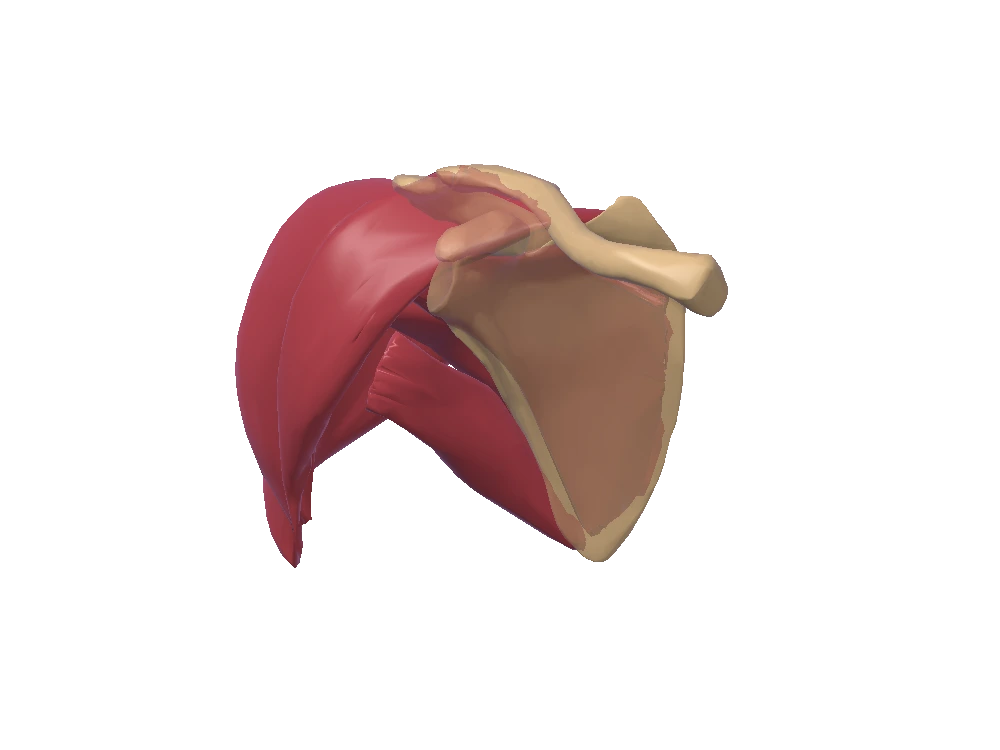
Key structures
- Right clavicle
- The collarbone links the shoulder girdle to the breastbone.
- Right scapula
- The shoulder blade provides muscle attachments and the shoulder socket.
- Right supraspinatus
- Rotator-cuff muscle.
- Right infraspinatus muscle
- Rotator-cuff muscle.
- Right subscapularis
- Rotator-cuff muscle.
- Right teres minor
- Rotator-cuff muscle.
How it moves
The shoulder blade and collarbone move together as a base for arm movement. The shoulder joint allows the arm to lift, reach and rotate. The rotator cuff helps keep the upper arm bone steady in its socket.
Common concerns
Repeated overhead movements can contribute to rotator-cuff problems, including tendon irritation and tears. Long-lasting stiffness may have several causes, including frozen shoulder or arthritis. Pain location alone cannot tell you which structure is involved.
When to see a doctor
Arrange an assessment if pain worsens, lasts more than two weeks or makes movement very difficult. Seek urgent care for sudden severe pain, inability to move the arm, major swelling, deformity, persistent numbness or feeling feverish and unwell.
Explore the interactive model
Rotate the reference model, switch the available layers and select a structure. The controls below open on right shoulder.
If the embedded atlas is difficult to use on your screen, open right shoulder in the full atlas.
Frequently asked questions
Does this view show every shoulder tendon?
No. The cuff muscles are represented, but their tendons are not a separate complete layer. The model is a learning aid, not a scan of your shoulder.
Should I stop using a mildly painful shoulder?
NHS guidance generally supports gentle movement while reducing activities that worsen pain. Ask for individual advice when movement is difficult.
Sources
These references support the anatomy and care information above. Model coverage is checked against the atlas catalogue.
- OpenStax: The Pectoral GirdleLink checked
- OpenStax: Anatomy of Selected Synovial JointsLink checked
- MedlinePlus: Rotator Cuff InjuriesLink checked
- NHS: Shoulder painLink checked
Read our editorial standards and anatomy model credits and limitations.