
REGIONAL ANATOMY · EXPLORE & UNDERSTAND
Back anatomy: spine, discs and back muscles
Explore back anatomy through vertebrae, cartilage discs and back muscles, with honest model limits and clear reasons to seek medical help.
Introduction
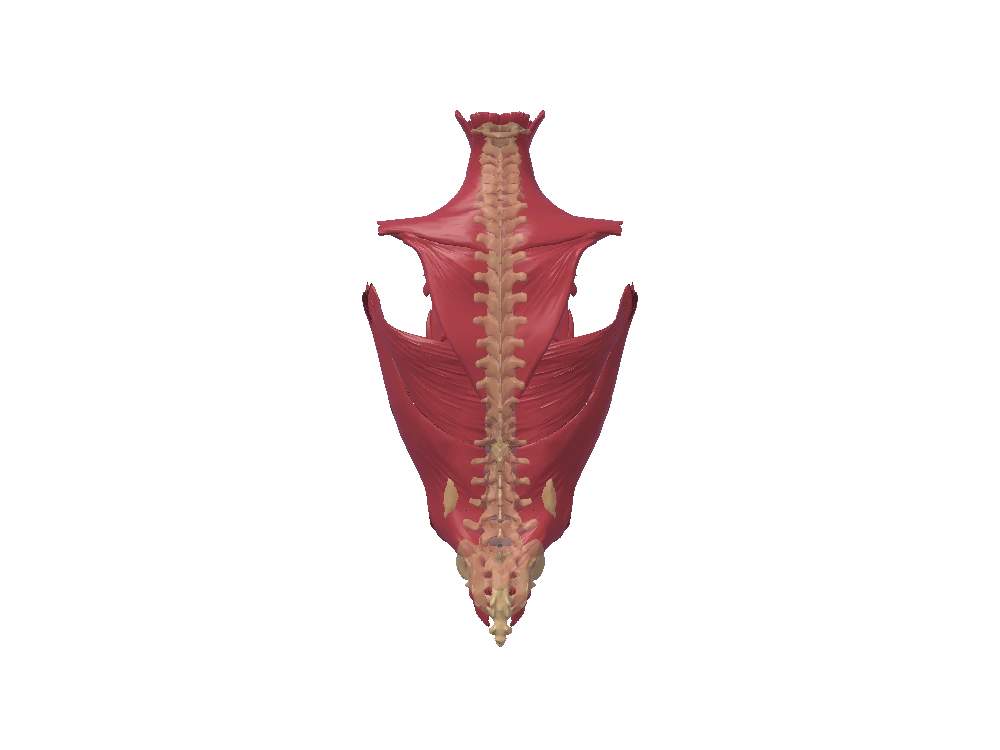
The back combines a flexible spinal column with overlapping muscles that support and move the trunk. Follow the neck, chest and lower-back vertebrae down toward the sacrum. The model includes intervertebral discs as cartilage. It does not show the spinal cord, spinal nerves or nerve roots, so it cannot illustrate nerve compression.
Key structures
- Vertebrae and sacrum
- Spinal bones support the body; the sacrum forms the base of this displayed column.
- Intervertebral discs
- Cartilage pads between vertebral bodies cushion load and permit small movements.
- Iliocostalis, longissimus and spinalis
- These represented erector spinae muscles help straighten and control the spine.
- Trapezius and rhomboids
- Muscles that position the shoulder blades on the back of the chest.
How it moves
Bending, straightening, turning and side-bending involve movement distributed through the spine. The erector spinae muscles help straighten it, while deeper muscles contribute to control. Other visible back muscles move the shoulder blades or upper arms, showing how the back connects trunk and limb movement.
Common concerns
Back pain is common and its cause is not always identifiable. A muscle strain is one possibility, but the appearance of a disc or muscle in a healthy reference model cannot diagnose your symptoms. Note how pain affects walking, sleep or ordinary tasks.
When to see a doctor
Seek assessment if pain persists for weeks or restricts daily life. Sudden severe or rapidly worsening pain, or pain with feverishness, needs urgent advice. Get emergency help for back pain with numbness around the genitals or anus, new bladder or bowel problems, or pain, weakness, tingling or numbness in both legs.
Explore the interactive model
Rotate the reference model, switch the available layers and select a structure. The controls below open on back & spine.
If the embedded atlas is difficult to use on your screen, open back & spine in the full atlas.
Frequently asked questions
Is an intervertebral disc a bone?
No. A disc is a cushioning structure made of fibrocartilage, with a softer centre. This atlas classifies its disc meshes as cartilage.
Can I locate the cause of sciatica here?
No. The nerves and nerve roots are missing, and symptoms need clinical assessment. This model helps identify surrounding anatomy, but cannot show whether a nerve is compressed.
Sources
These references support the anatomy and care information above. Model coverage is checked against the atlas catalogue.
- OpenStax: The vertebral columnLink checked
- OpenStax: Axial muscles of the head, neck and backLink checked
- OpenStax: Muscles of the pectoral girdle and upper limbsLink checked
- NHS: Back painLink checked
Read our editorial standards and anatomy model credits and limitations.